Product Sketch #2: Surfacing the Planning Layer
This week I’ve been thinking about the stage before AI creates anything.
Most AI creation tools follow a fairly simple interaction loop: you type a prompt, wait for a bit, and receive an output. Sometimes the result genuinely feels magical, but the interaction itself is usually passive once generation begins.
The more I use these tools, the more I realize the interesting part is (sometimes) not the final artifact, but the brainstorming beforehand — the messy sketches, branching ideas, technical trade-offs, and “what if we tried this instead?” moments that gradually shape a project.
A lot of current interfaces make this part of the process mostly invisible. Either users wait silently while the model works, or they watch streams of raw tokens that are difficult to meaningfully follow. What interests me more is the possibility of making the process itself legible: visualizing evolving ideas, assumptions, and open questions in a way that invites participation instead of passive observation.
I wonder what it would feel like if interacting with an AI system felt less like issuing commands to a machine and more like thinking alongside a creative partner.
This prototype is a small experiment in that direction.
Making Thinking Visible
The workflow begins with a simple prompt. For example:
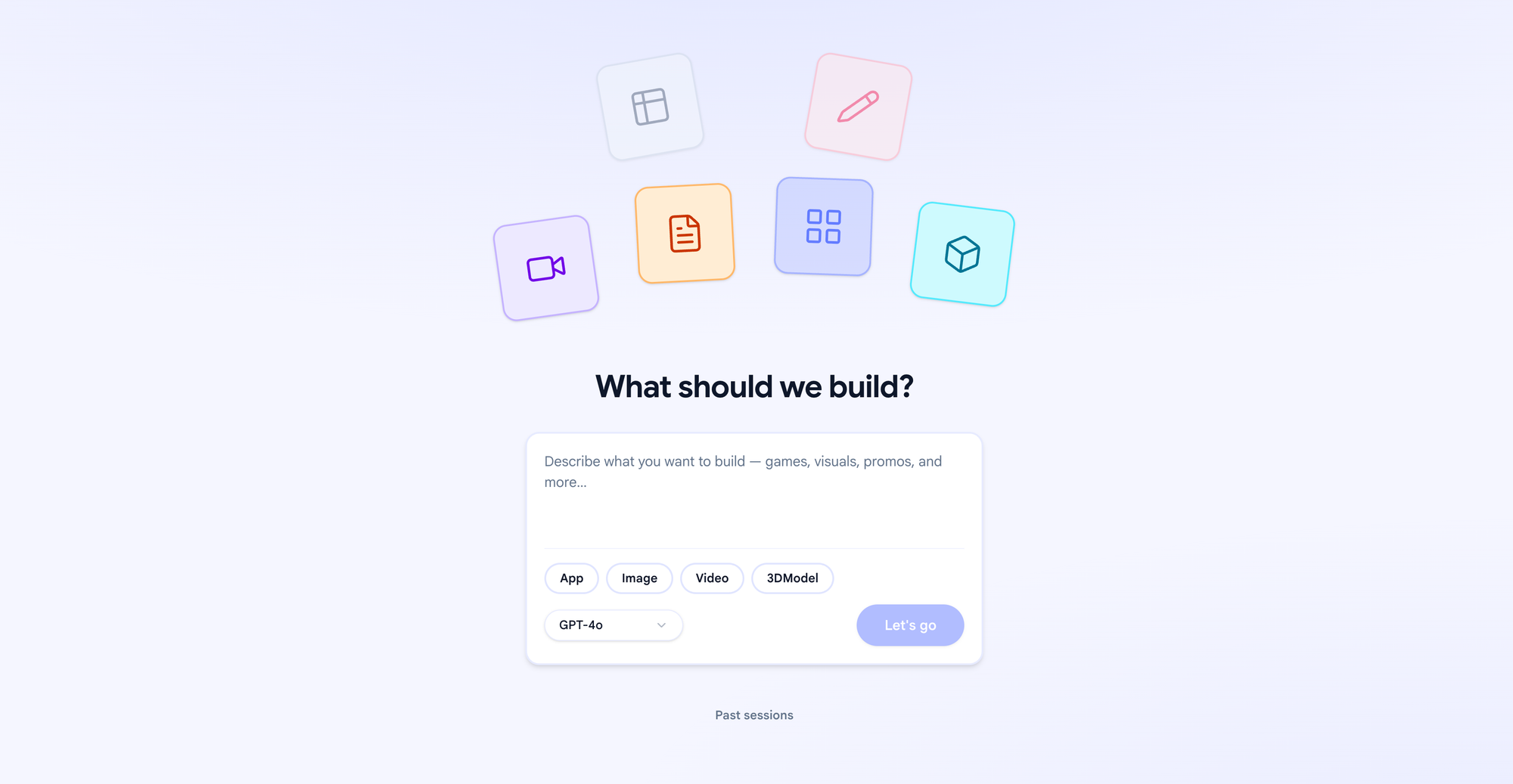
“Create a snake game where the player controls a snake with arrow keys, includes score tracking, game over screen with restart, and smooth animations.”
Once the user submits the idea, a main language model begins reasoning through the problem in real time. Instead of only exposing the raw thinking stream directly to the user, a second smaller model continuously interprets the stream and converts it into lightweight sticky notes.
These notes are not meant to reproduce chain-of-thought reasoning perfectly. Instead, they function more like fragments from an evolving creative workspace: assumptions, implementation directions, questions, possible mechanics, or small design decisions that emerge during planning.
Rather than watching tokens appear line-by-line, the user watches the workspace slowly organize itself.
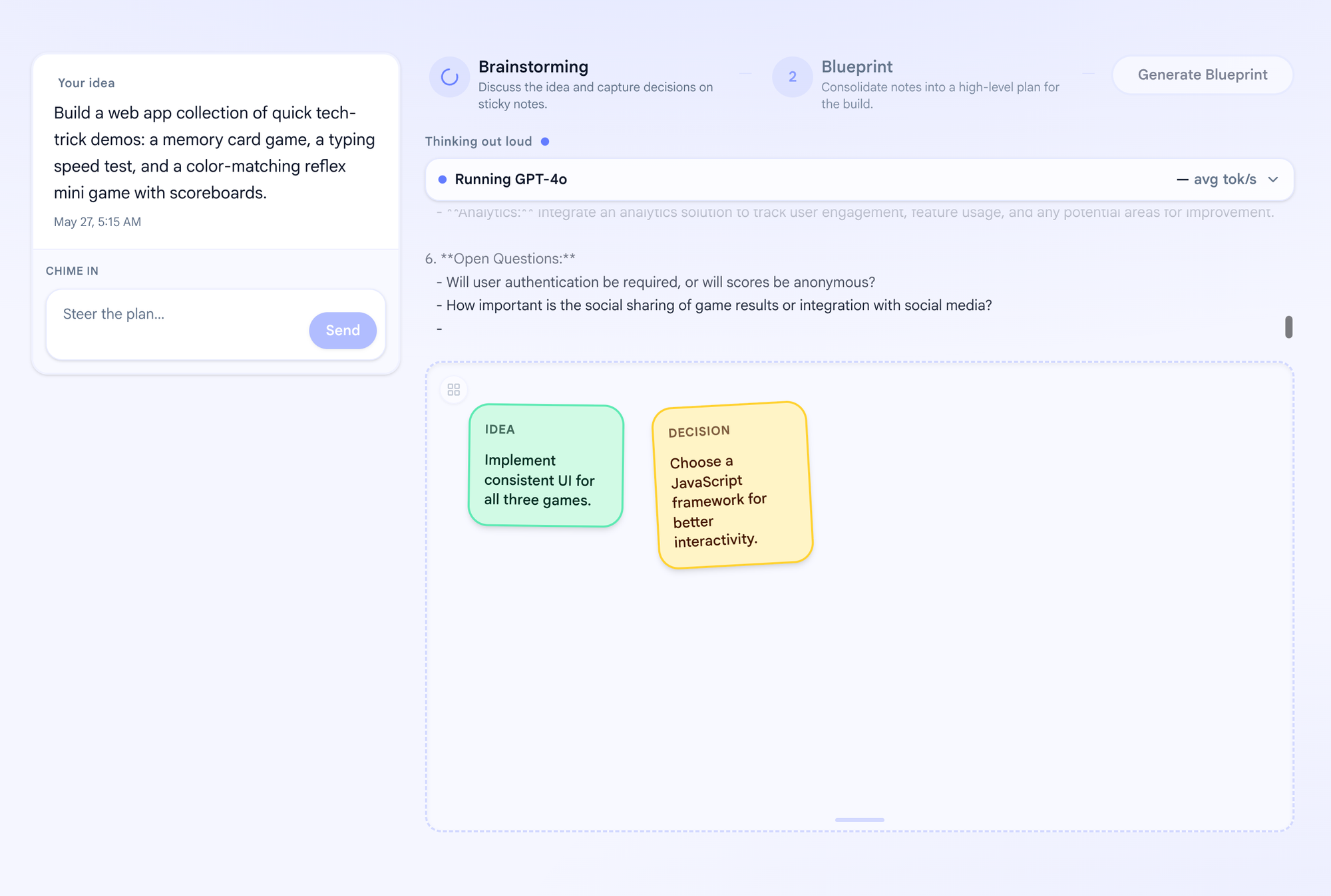
During the brainstorming stage — even while the model is still generating — the user can continuously “chime in” with follow-up thoughts or adjustments. Notes can be referenced directly, updated, or expanded without restarting the process from scratch. Once the brainstorming feels sufficiently complete, the system consolidates the evolving notes into a higher-level blueprint that organizes the project into implementation sections and tasks. Only after that does the workflow transition into the build stage.
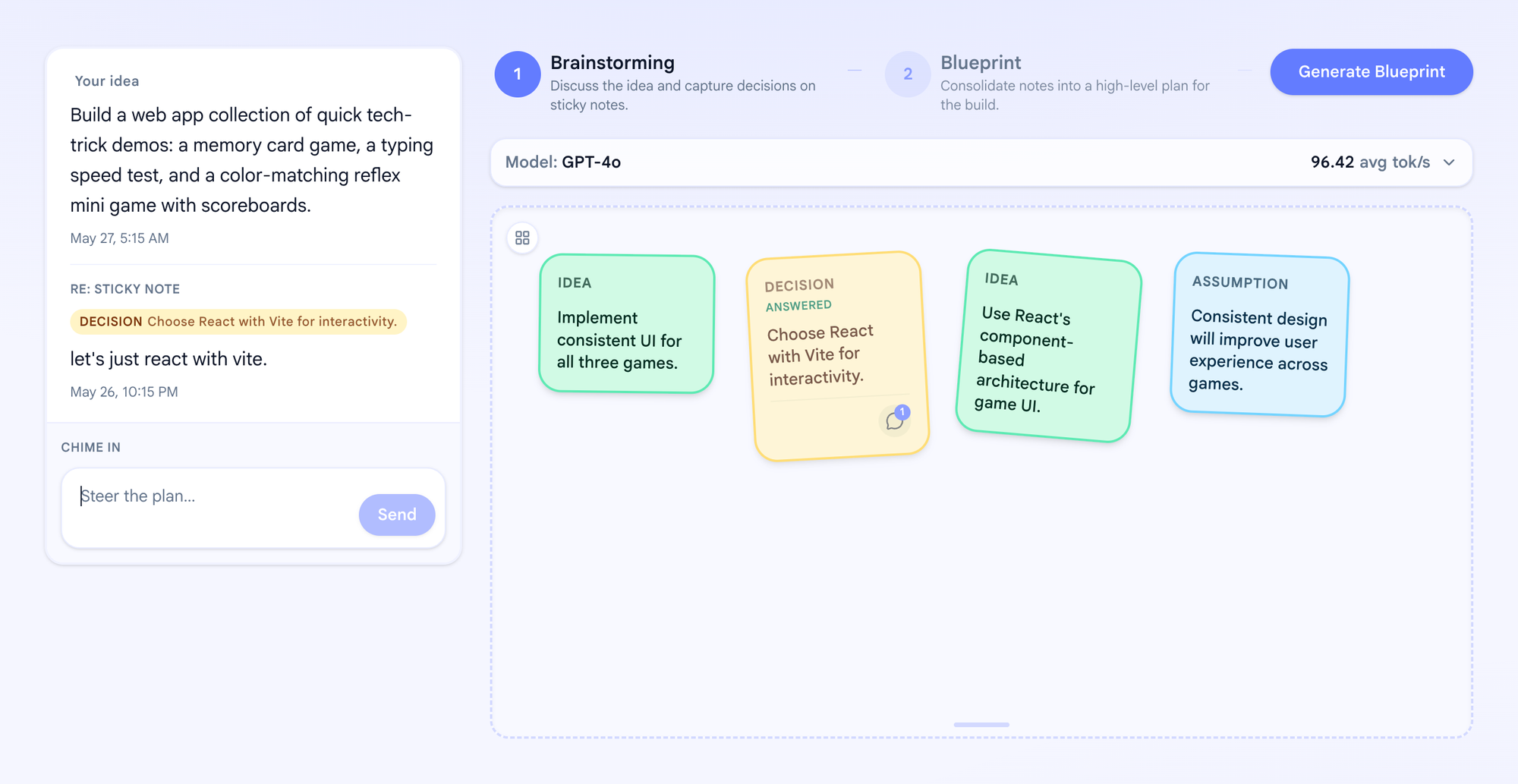
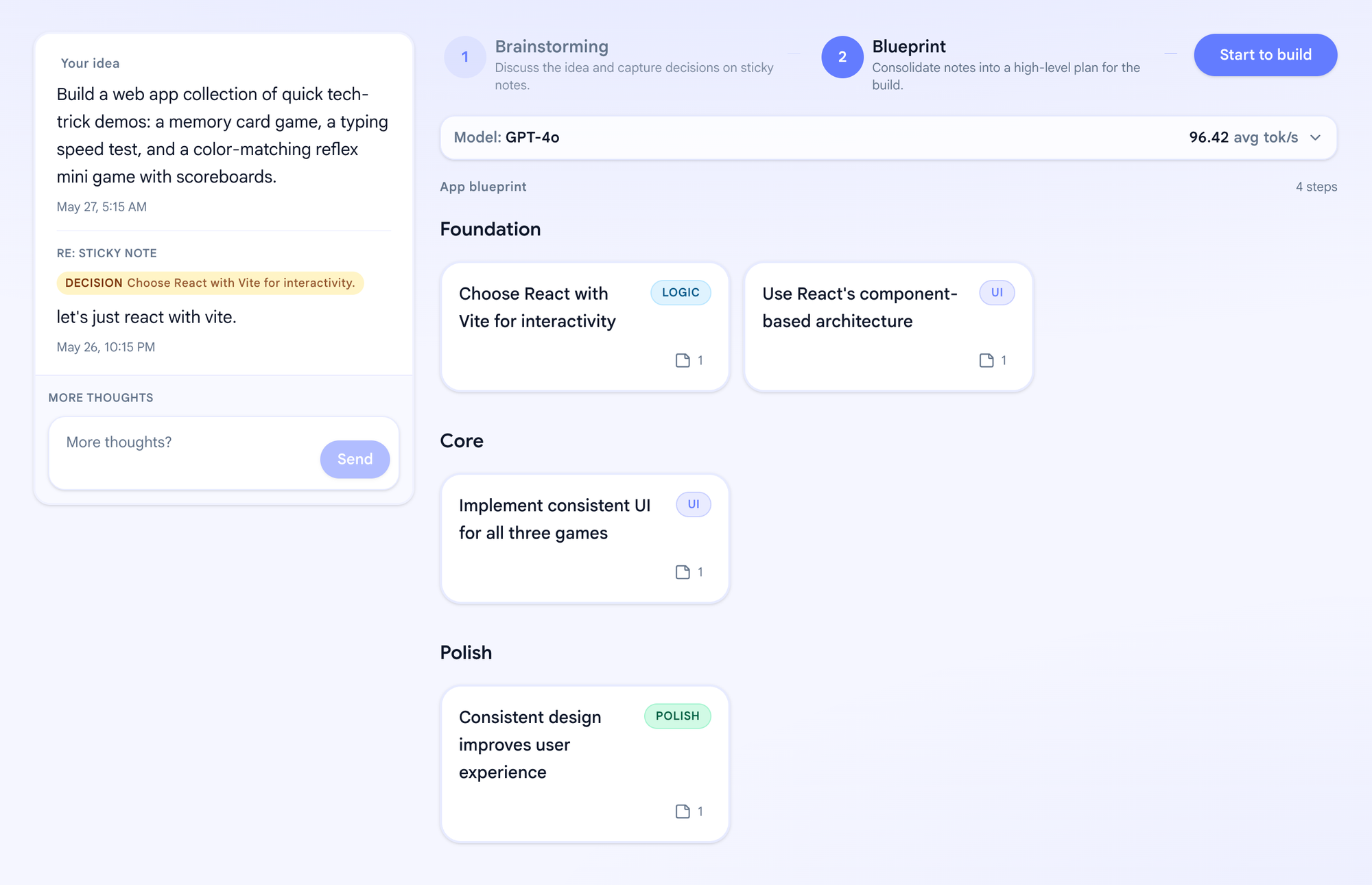
What became interesting to me while building this prototype was that the final artifact felt like only one part of a larger creative loop. There is value in the planning before anything is built, value in the artifact itself, and value in the iterations that happen after the first version exists. The system does not necessarily need to own every generation pipeline end-to-end; it can still provide a meaningful workspace around the moments where ideas are shaped, evaluated, revised, and turned into something shareable.
From "Vibe Coding" to "Vibe Making"
“Vibe coding” is only an early version of a much larger shift in how people interact with generative tools.
In the future, people may casually create not only apps, but also animations, simulations, CAD models, interfaces, architectural layouts, 3D-printable objects, or entirely new kinds of interactive media. Each output type will likely require its own specialized generation pipeline, models, and workflows, and many startups are exploring different pieces of that future. What feels more universal to me for this tool is the exploratory layer before creation fully solidifies.
When I think about it, there may eventually be at least two broad categories of “vibe-making” workflows. One is closer to what many AI tools already resemble today: a structured collaborative process where the user initializes an idea and the system gradually expands it into something buildable. The other feels more conversational and improvisational — less like orchestrating a pipeline and more like exchanging ideas continuously with another participant in the room.
I don't think these approaches are mutually exclusive. They may simply represent different modes of human-machine creativity.
This also reminds me of a talk I attended a while ago where Ken Liu spoke about AI and art. One idea from the discussion stayed with me afterward: that there are perhaps two different dimensions of art — imitation and meaning-making. Generative AI may become extraordinarily good at helping people produce work that matches a particular vision or aesthetic, but the deeply human part still feels connected to interpretation, perspective, and the act of assigning meaning.
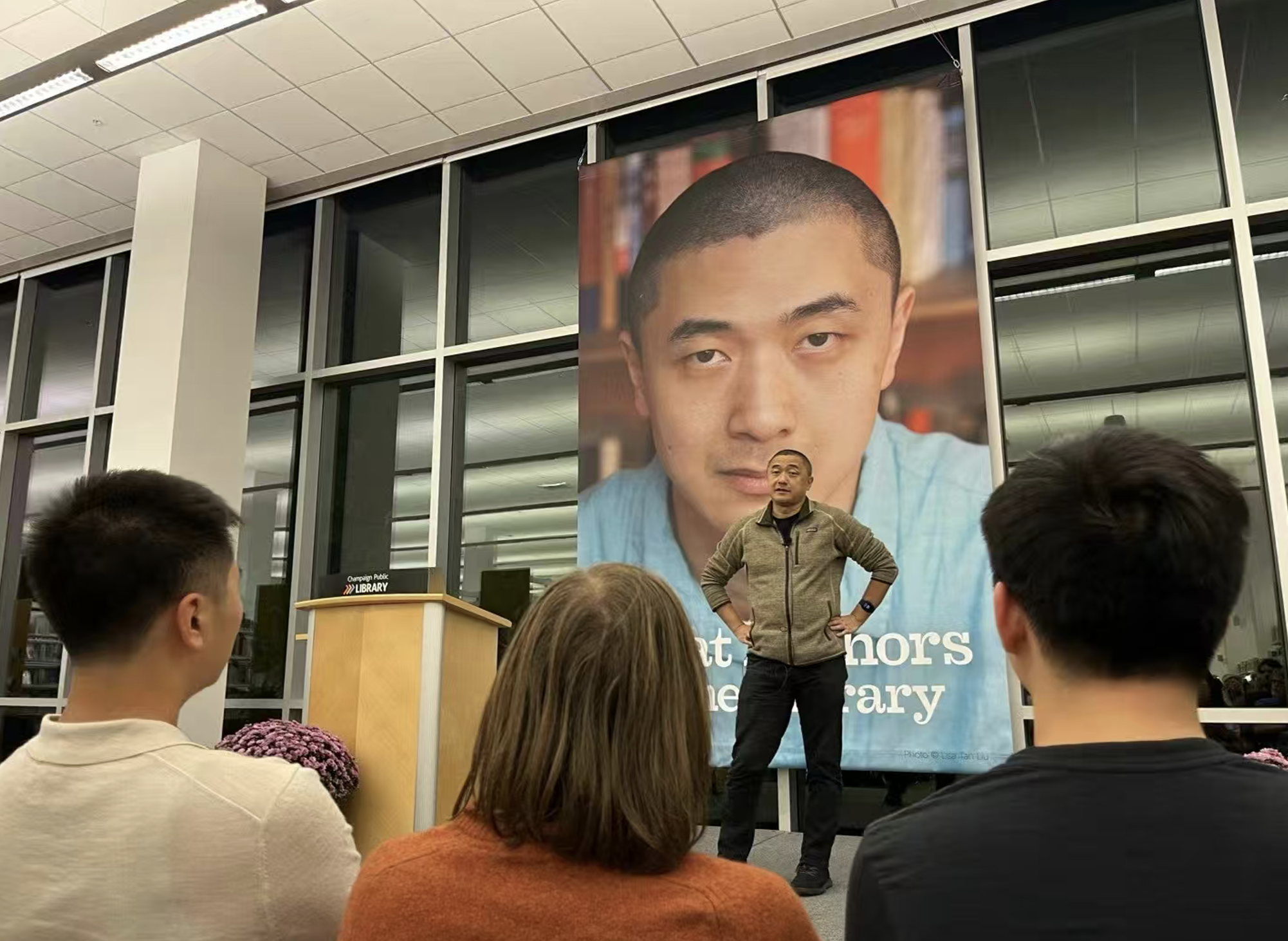
The most interesting part of creative work may not simply be the final generated artifact, but the collaborative process of exploring possibilities and gradually constructing meaning together.